AI doesn’t fix chaos. It scales it.
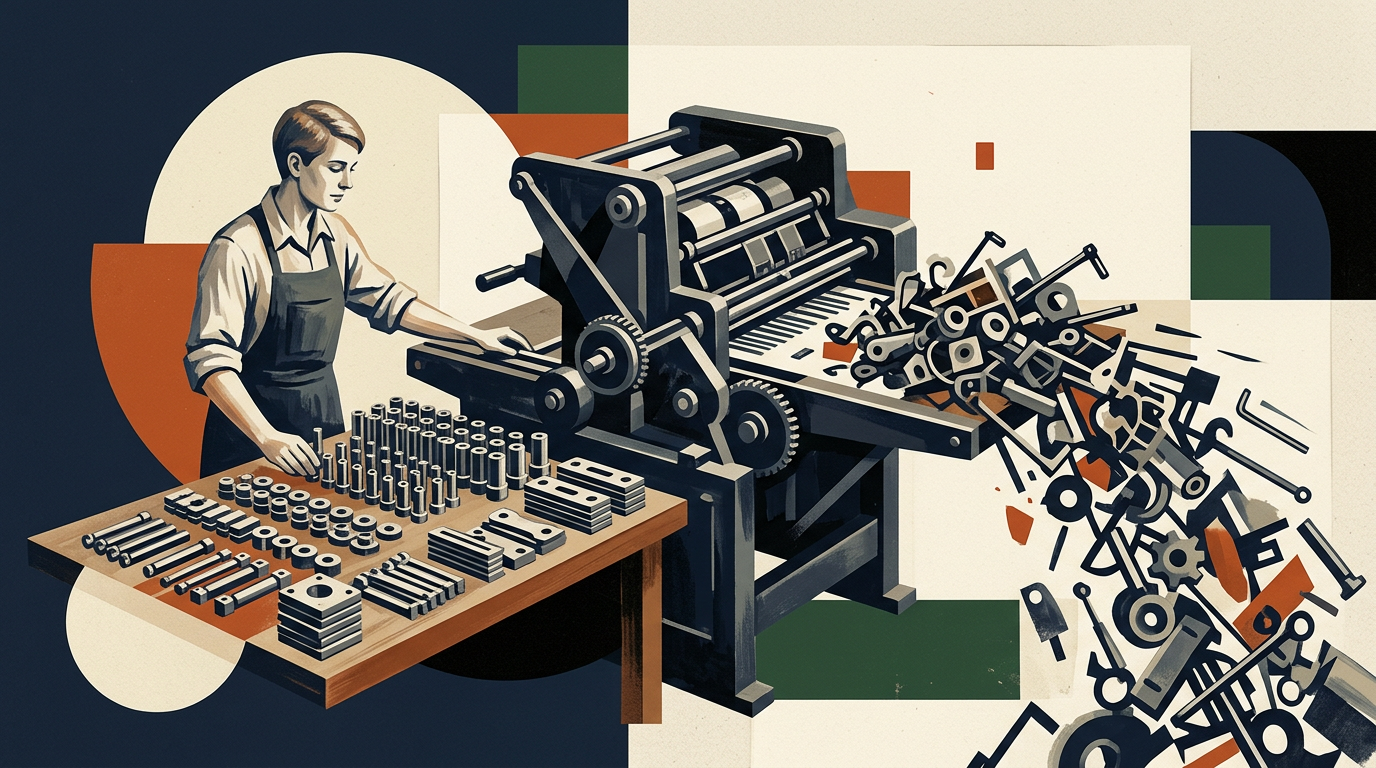
The promise of AI for business operations goes something like this: take your messy, time-consuming processes, feed them into an AI tool, and watch the output become faster and better. The reality, for most organisations that have not done the foundational work first, is different. What AI actually does is take your existing inputs and produce outputs at greater speed and volume. If the inputs are good, the outputs are good. If the inputs are chaotic, you get confident, high-volume chaos.
AI is a multiplier. Multipliers work in both directions.
The confidence problem
The specific danger of AI-generated outputs based on poor inputs is not the errors themselves – it is that the errors are invisible.
A messy spreadsheet looks like a mess. A human working with it can see immediately that something is wrong: the categories are inconsistent, half the fields are empty, the naming conventions changed three years ago and nobody standardised the old entries. They slow down, ask a question, or flag the problem.
An AI working with the same spreadsheet produces a polished output – a report, a product description, a customer segment, a process summary – that looks authoritative regardless of what it was built on. The mess is not visible in the output. It is embedded in it, now formatted and presented with the appearance of accuracy.
This makes AI-generated errors systematically harder to catch than human errors. The human error announces itself through hesitation, a question, or an obvious gap. The AI error presents as a conclusion.
Data chaos, amplified
Most businesses have data problems they are aware of and have been meaning to fix. The product catalogue where attributes are inconsistently labelled. The CRM where the same customer appears under three slightly different names and two email addresses. The sales data where some rows use one currency convention and others use another because someone changed the template in 2022 and not everything was migrated.
These problems slow down human work. They do not stop it, because humans apply context. They know that “T-shirt – blue – L” and “Blue T-shirt (L)” are the same product. They know that the €12,000 entry is probably in a different currency because it does not fit the range of the others.
AI does not apply that kind of contextual judgment. It works with what is there. Feed it an ecommerce catalogue with inconsistent product attributes and ask it to generate product descriptions – it will generate descriptions that inherit and amplify the inconsistencies, at a rate no human could match. Ask it to segment your customer list and it will produce confident segments based on data that has duplicates and gaps it cannot see.
The businesses that get real value from AI in their operations are almost always the ones that did the data work first: agreed definitions, consistent formats, clear ownership of who updates what and when. AI then compounds good data. It does not compensate for bad data.
Process ambiguity, accelerated
The same principle applies to processes. Any process that works in a business exists because the people running it are filling in the gaps with judgment – they know when to escalate, when to make an exception, what “done” means even when the documentation does not specify it.
Add AI to an ambiguous process and you remove the human judgment without replacing it with anything. The AI does not know to pause at the ambiguous step. It proceeds, confidently, based on whatever inputs it has, and produces an output that may be completely wrong for reasons a human participant would have caught.
A customer service workflow where the escalation criteria have never been written down relies on experienced staff making good calls. Replace that workflow with an AI tool and you get fast, consistent processing of the cases that are clearly in scope – and confident mishandling of anything that requires the judgment that was never documented. The rate of mishandling increases because the speed increases.
Before any process can be usefully automated or augmented with AI, it needs to be documented well enough that the AI has something to work from. That means clear inputs, clear criteria for each decision point, and a clear definition of the output. This is not AI work. It is process work that should have been done regardless.
Responsibility without owners
The third failure mode is accountability. In any functioning organisation, every significant decision has an owner – a person who is responsible for making it and who can be asked about it later. AI introduces a new category of output that organisations frequently fail to assign ownership to.
“The AI produced it” is not an accountability structure. If the AI-generated content on your website is wrong, who is responsible for reviewing it before publication? If the AI-generated customer communication goes to the wrong segment, who owns that decision? If the AI-assisted analysis produces a recommendation that turns out to be based on flawed inputs, who catches it?
The absence of clear ownership is not a new problem in most organisations – it predates AI. What AI does is generate outputs at a rate that makes the problem unavoidable. When a human produces one report per week, an unclear ownership structure causes occasional problems. When an AI produces fifty reports per week, the same unclear structure causes fifty times the problems at the same rate.
The operational discipline required to use AI well is: every AI output has a defined owner. That person reviews it before it acts on anything. That person is accountable for what the output does in the world. This sounds simple. Most organisations implementing AI tools have not established it.
What AI readiness actually requires
The organisations that get sustained value from AI are not necessarily the ones with the most sophisticated tools. They are the ones that did the boring work before reaching for the tools.
On data: consistent formats, agreed definitions, clear naming conventions, a single source of truth for each type of data, and a defined process for keeping it current. This is data governance work that most businesses need to do anyway. AI makes it more urgent, not optional.
On processes: documentation that is good enough to hand to someone who has never done the job. If the process exists only in the heads of the people who run it, it is not ready for AI augmentation. Write it down first. Find the ambiguous steps and resolve them. Then evaluate which parts AI can usefully handle.
On responsibilities: for every AI-generated output that will be acted upon, someone is responsible for reviewing it. That person is named. Their review criteria are clear. The process does not move forward until a human has confirmed the output is fit for use.
None of this is glamorous. None of it looks like the AI demos where a business is transformed overnight by a tool that does everything automatically. But it is what actually works, and it is what separates the businesses that get real operational benefit from AI from the ones that implement tools quickly, find the results unreliable, and conclude that AI does not work for them.
It works. The preconditions for it working are not technical. They are organisational.
The silver lining
There is a useful side effect of taking AI readiness seriously: the work required to get ready is the work you should have done anyway.
Cleaning up your product data makes your ecommerce site faster to search and your SEO more effective, regardless of whether you ever add AI. Documenting your processes makes onboarding new staff cheaper and your operations more resilient. Clarifying ownership structures reduces the errors and delays that come from ambiguity. These are improvements to the business that compound over time.
AI is a useful forcing function for doing them. The businesses that approach AI readiness as an operational improvement project rather than a technology implementation project tend to come out of it with both – a better-run operation and AI tools that actually work within it.
For help assessing where your data, processes, or digital infrastructure are ready for AI augmentation and where the foundational work still needs to happen, the AI integration page and technical consulting page cover what that looks like in practice.